
Best Portable Air Conditioner for Bedrooms & Hot Sleepers
This post may contain affiliate links, which means I may earn a small commission if you make a purchase through these links — at no extra cost to you. Thank you for supporting the content I create here on the blog! You can read my full Disclosure Policy for more details.
When we first moved to the US, we lived without central air for months. Finding the best portable air conditioner for bedroom survival became my personal mission. We have since moved to a condo with central AC, but I haven’t forgotten the humid trenches. Those years of relying on portable AC units in summer gave me an unofficial degree in bedroom cooling tech.
Unlike a standard fan, a compressor-based portable air conditioner actually extracts heat and humidity from the air.
To save you from scrolling through thousands of confusing Amazon listings, I’ve narrowed the market down to three top-performing recommendations, plus my personal favorite and best portable air conditioner for bedrooms, in my opinion!
Full Transparency Note: I do not own all three of these units. I personally relied heavily on our top pick (the Midea Duo) in our master bedroom for years. The other two picks are my runners up based on my own research so you can make an informed and confident choice!
Quick Answer: For most homes, the best portable air conditioner for bedroom setups is the Midea Duo. It delivers impressive cooling capacity, low nighttime operating sound, manageable drainage, and bedroom-friendly display controls. Choose the BLACK+DECKER as a portable AC for small bedroom layouts on a tight budget, or select the Whynter ARC-14S if you need a best dual-hose portable air conditioner to fight intense sun exposure and high ceilings.
Bedroom AC Comparison Table
| Portable AC | Best For | DOE SACC | Hose Design | Noise Level | Price Tier |
| Midea Duo 14K | Best Overall & Quiet Sleeping | 12,000 BTU | Hose-in-Hose | 42–49 dB | $$$ |
| BLACK+DECKER 8K | Best Budget & Small Bedroom | 5,000 BTU | Single Hose | ~53 dB | $ |
| Whynter ARC-14S | Large or Extremely Hot Bedroom | 9,500 BTU | Dual Hose | ~52 dB | $$$ |
Best Portable Air Conditioner for Bedrooms Overall
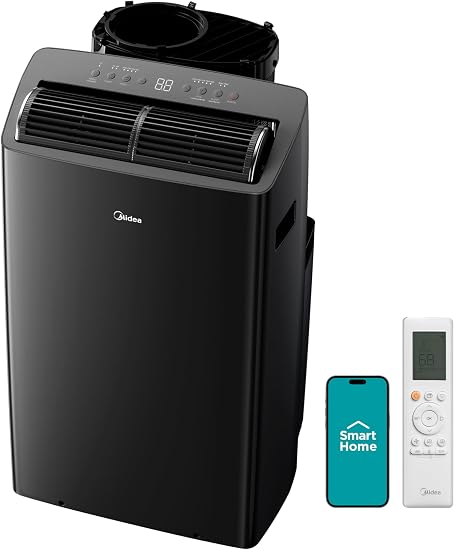
- Whisper-quiet inverter cooling won’t interrupt your beauty sleep.
- Powerful enough to turn a hot master bedroom into a chilly retreat.
- Smart controls and smooth temperature changes make overnight cooling effortless.
This is an affiliate link. As an Amazon Associate, I earn from qualifying purchases.
Before we had central AC, this was the exact unit sitting proudly in our master bedroom, and I can honestly say it saved my sleep. Barry still insisted on sleeping under a heavy duvet even in July, while I was contending with nightly infernos. The Midea Duo’s variable-speed inverter compressor meant it didn’t make that alarming clunk-thump sound when cycling on in the middle of the night. It smoothly ramped up and down, keeping our bedroom ice-cold without waking me up every hour.
The Key Specs:
- Cooling Capacity: 12,000 BTU SACC (14,000 ASHRAE)
- Room Coverage: Up to 550 sq. ft.
- Design Profile: Hose-in-hose design with variable-speed inverter compressor
- Noise Level: 42 dB (on lowest setting)
The Verdict: An overall winner must balance real-world cooling speed, nighttime noise control, energy draw, and user-friendly controls. It was easily the quietest portable AC for sleeping during our non-central-air years.
- Main Advantage: Inverter technology delivers whisper-quiet operation and precise temperature maintenance.
- Main Disadvantage: The combined hose-in-hose exhaust tube is thick and requires a sturdy window placement.
Best Affordable Portable AC for a Small Bedroom
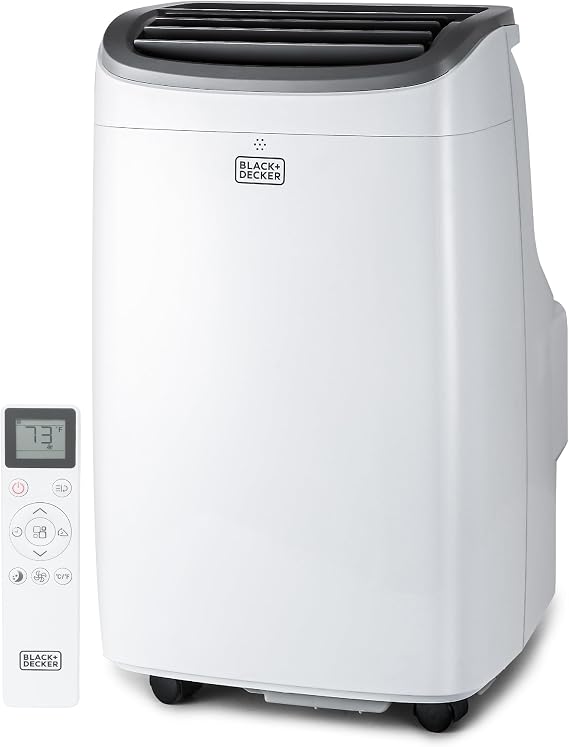
- Delivers reliable bedroom cooling without draining your summer budget.
- Compact, easy to move, and ideal for guest rooms or smaller spaces.
- Simple setup means you can go from sweaty to comfortable with minimal fuss.
This is an affiliate link. As an Amazon Associate, I earn from qualifying purchases.
While I didn’t own this specific unit during our portable AC years, I thoroughly researched it for readers who need reliable relief without spending a fortune. ENERGY STAR guidelines clearly state that bigger is not always better—over-sizing an AC unit in a tight space can leave the air feeling clammy. If you are outfitting a small guest room, nursery, or secondary space where your current airflow is weak, this model comes highly verified by thousands of Amazon reviewers. It’s a straightforward portable air conditioner for bedrooms without central air that gets the job done.
The Key Specs:
- Cooling Capacity: 5,000 BTU SACC (8,000 ASHRAE)
- Room Coverage: Up to 350 sq. ft.
- Design Profile: Single-hose design with standard fixed-speed compressor
- Noise Level: ~53 dB (on highest setting)
The Verdict: This unit costs significantly less, but it relies on a traditional fixed-speed compressor. That means you will notice the compressor cycling on and off. However, its small footprint and smooth casters make it a top contender if you need a budget-friendly portable air conditioner on Amazon.
- Main Advantage: Excellent value for money, simple installation, and compact footprint.
- Main Disadvantage: Fixed-speed compressor leads to noticeable sound changes when cooling kicks in.
Best Portable AC for a Large or Extremely Hot Bedroom
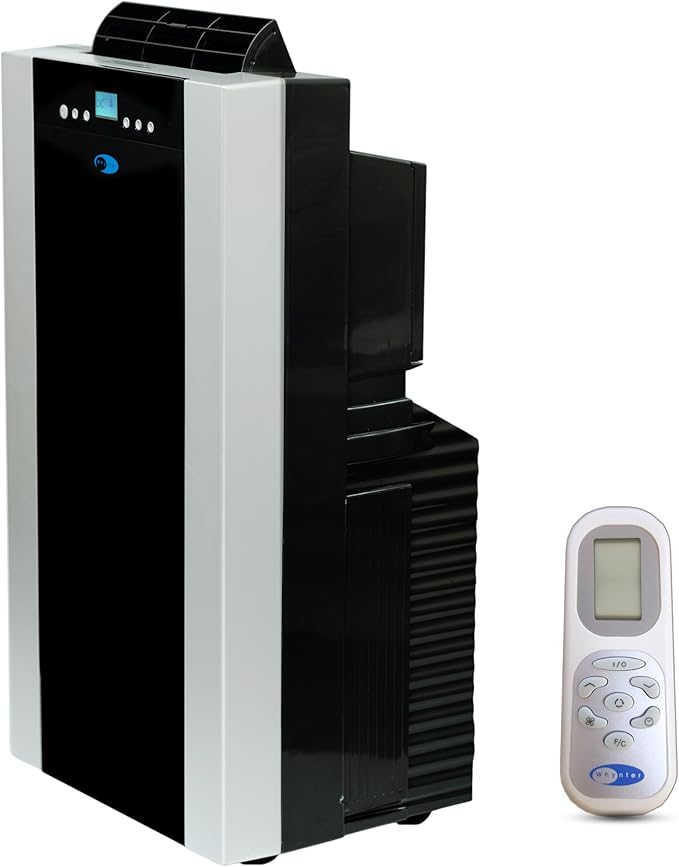
- Heavy-duty cooling tackles blazing sun, high ceilings, and stubborn upstairs heat.
- Dual hoses keep hot air from sneaking back into your freshly cooled bedroom.
- Serious dehumidifying power helps banish that sticky, muggy feeling fast.
This is an affiliate link. As an Amazon Associate, I earn from qualifying purchases.
Even though we have central AC today, I know that upper-floor bedrooms with vaulted ceilings or west-facing windows often still trap brutal heat. When looking at technical performance metrics, the Whynter ARC-14S consistently emerges as a heavy-duty workhorse. Single-hose units can struggle in severe heat because they create negative pressure inside the room. This dual-hose setup draws outdoor air to cool its internal coils, making it a top-tier best portable air conditioner for hot bedroom spaces that weaker units simply can’t handle.
The Key Specs:
- Cooling Capacity: 9,500 BTU SACC (14,000 ASHRAE)
- Room Coverage: Up to 500 sq. ft.
- Design Profile: Dual-hose design with heavy-duty fixed-speed compressor
- Noise Level: ~52 dB (on high speed)
The Verdict: If your room suffers from poor insulation, massive windows, or high humidity, this heavy-duty unit offers serious air displacement. It pulls an incredible 71 pints of moisture per day, making it an ideal portable AC for large bedroom layouts facing extreme summer weather.
- Main Advantage: Dual-hose design prevents hot air from leaking back into the room under doors.
- Main Disadvantage: The unit is heavy (80 lbs) and the dual-hose window assembly takes up significant window real estate.
Decoding Portable AC Specs: SACC, Hoses, and Inverters
Navigating product listings on Amazon can feel like reading another language. Let’s break down the technical terms so you know exactly what you’re buying.
What Does DOE SACC Mean?
When looking at product titles, you’ll almost always see two BTU ratings:
- ASHRAE Capacity: An older laboratory rating method that measures raw cooling output under ideal test conditions. Marketing teams love this number because it’s higher.
- DOE SACC (Seasonally Adjusted Cooling Capacity): The federal testing standard mandated by the U.S. Department of Energy. It factors in real-world variables, such as heat generated by the unit itself and outdoor air leakage.
Always compare models using the DOE SACC rating. Comparing one unit’s ASHRAE number to another unit’s SACC number will give you an inaccurate picture of performance.
Single-Hose vs. Dual-Hose vs. Hose-in-Hose
The federal test procedure explicitly accounts for single-duct vs. dual-duct operation because hose configuration alters efficiency:
- Single-Hose (e.g., BLACK+DECKER): Expels hot air outdoors through one hose. This creates slight negative pressure inside the bedroom, which can pull warm air in from adjacent hallway spaces. They are typically cheaper and easier to set up.
- Dual-Hose (e.g., Whynter): Uses one hose to draw outdoor air in for cooling internal coils and a second hose to exhaust the hot air back outside. This eliminates negative pressure issues in severe heat.
- Hose-in-Hose (e.g., Midea Duo): Combines the dual-hose mechanism inside one streamlined, flexible tube. You get the efficiency of a dual-hose system without dealing with two separate, bulky pipes.
Inverter vs. Fixed-Speed Compressors
- Fixed-Speed: Operates like a light switch—it’s either running at 100% power or completely off. When room temperatures drift, it turns on with a loud kick, which can startle light sleepers.
- Inverter (Variable-Speed): Functions more like an accelerator pedal. It adjusts its motor speed dynamically. Once your bedroom reaches the target temperature, it scales down to a low, whisper-quiet hum to maintain that temperature continuously.
How Portable ACs Compare to Other Cooling Solutions
| Cooling Solution | Removes Heat? | Dehumidifies? | Installation Needed? |
| Portable AC | Yes | Yes | Minimal (Window Kit) |
| Tower/Pedestal Fan | No | No | None |
| Bed-Cooling System | Localized | No | Mattress Pad Assembly |
| Central / Window AC | Yes | Yes | Permanent or Semi-Permanent |
Portable AC vs. Tower or Pedestal Fan
A fan does not cool room air; it simply blows air over your skin to assist with evaporative cooling. If your room is 85°F, a fan will simply blow 85°F air at your face. If you’re deciding whether air circulation alone is enough, our guide comparing a Tower Fan vs. Pedestal Fan details when a fan suffices versus when you need actual refrigeration. Choose a portable air conditioner for sleeping when you need to actively drop the ambient room temperature and reduce sticky humidity.
Portable AC vs. Window Air Conditioner
Window units are generally more energy-efficient and take up zero floor space. However, many rental agreements, HOAs, or narrow window styles don’t allow heavy window units hanging outside. Portable air conditioners give you flexibility, store away easily in winter, and don’t permanently alter your window frame.
Portable AC vs. Bed-Cooling Systems
While a portable air conditioner lowers the ambient air temperature throughout the entire room, active mattress cooling systems target body heat trapped directly underneath you. If your body heat is trapped in a thick mattress and the room air is hot, pairing a portable unit with one of the Best Bed-Cooling Systems yields the ultimate relief for extreme hot sleepers.
Installation, Safety, and Drainage Essentials
To keep your unit running efficiently and safely, follow these core setup rules:
1. Measure Your Windows First
Before buying, grab a tape measure and check your window dimensions:
- Measure the inside width and height of the window opening.
- Note your window type (double-hung, horizontal slider, or casement).
- Most Amazon units ship with standard sliding window panels. Casement (crank-out) windows usually require a fabric seal adapter kit sold separately.
2. Optimize Hose Placement
A poorly configured exhaust hose acts like a radiator putting unwanted heat back into your bedroom. Keep the exhaust hose as short and straight as possible. Avoid sharp kinks, and never crush or over-extend the ducting beyond what the manual permits.
3. Understand Drainage Requirements
Air conditioners collect moisture from the air as they cool. Modern models feature self-evaporating technology that exhausts most water out through the window hose. However, during periods of extreme high humidity, the internal reservoir may fill up, requiring you to drain it manually via a bottom plug or connect a gravity drain hose.
4. Direct Electrical Connection Only
Critical Safety Warning: Plug your portable AC directly into a dedicated wall outlet. The Consumer Product Safety Commission (CPSC) warns against using light-duty extension cords or power strips with major heating and cooling appliances, as undersized wires can overheat and pose a fire hazard.
Solving Specific Bedroom Cooling Challenges
Portable AC for Menopause & Night Sweats
A portable AC won’t treat the hormonal causes of night sweats, but lowering room temperatures dramatically improves your sleep quality during thermal spikes. If you’re wrestling with mid-life hormonal changes, my deep dive on How to Reduce Menopause Night Sweats breaks down everything.
Recommended Routine:
- Turn your AC on 30 minutes before bedtime to pre-chill the room.
- Pair the cooler air with lightweight, moisture-wicking bamboo or linen sheets.
- Keep a glass of ice water and the AC remote on your nightstand.
Managing Different Temperature Preferences with a Partner
Living with a partner who runs cold while you sleep hot requires strategy. Set the AC to cool the room to a comfortable baseline (e.g., 68°F–70°F), and direct the louver airflow toward your side of the bed. Use dual-zone bedding—a thin sheet for you, and a heavier duvet for your partner.
Memory Foam Mattress Heat Trapping
Memory foam responds to body heat to contour around your joints, but that dense construction also traps heat against your lower back and legs. An air conditioner chills the air around you, but if your mattress surface itself still feels like a heating pad, check out our guide on How to Make a Memory Foam Mattress Sleep Cooler to fix thermal buildup right at the mattress level.
Simple Maintenance for Maximum Efficiency
To ensure your unit runs reliably season after season, keep up with these basic maintenance tasks:
- Filter Cleaning: Wash or vacuum the dust filter every two weeks during summer use. Clogged filters restrict airflow and force the compressor to work harder, increasing energy bills.
- End-of-Season Storage: Before packing the AC away for winter, drain all residual water completely using the bottom drain plug to prevent mold growth.
- Keep It Upright: Always transport and store your portable air conditioner in an upright position to protect the compressor oil distribution. If a unit was tilted during shipping, let it stand upright for 24 hours before plugging it in.
FAQs
What portable air conditioner is best for a bedroom?
The Midea Duo Smart Inverter is our top overall pick because its variable-speed compressor prevents disruptive nighttime sound changes and provides high cooling power.
How many BTUs do I need for a bedroom?
As a general rule, a 5,000 to 6,000 DOE SACC unit covers small bedrooms (up to 350 sq. ft.), while an 8,000 to 12,000 DOE SACC unit handles medium to large bedrooms (400 to 550+ sq. ft.).
Is a dual-hose portable AC better than a single-hose?
In large or hot spaces, yes. Dual-hose models prevent negative air pressure, meaning they won’t pull warm air from surrounding rooms into your cooled bedroom.
Are inverter portable air conditioners quieter?
Yes. Because inverter compressors continuously modulate speed instead of abruptly switching fully on and off, they produce a smooth background hum rather than harsh operational clicks.
Can a portable air conditioner run all night?
Yes. As long as the exhaust hose is properly vented outdoors and the electrical outlet meets safety requirements, portable ACs are designed to operate continuously overnight.
Does every portable AC require a window?
Yes. Compressor-based cooling systems create heat as a byproduct. That hot air must be vented outdoors via a window kit or wall opening.
Do portable air conditioners need to be drained?
Most modern units self-evaporate condensation out the exhaust hose during normal cooling. However, in regions with extreme humidity, manual draining may be required periodically.
Can I use an extension cord with my portable AC?
No. Major appliances should always be plugged directly into a grounded wall outlet to avoid overheating and electrical hazards.
Why does my portable AC have two different BTU numbers?
The higher number is the older ASHRAE rating, while the lower number is the updated, stricter DOE SACC rating required by federal standards.
Final Recommendations
If you’re ready to take control of your sleep temperature and reclaim your nights from muggy heat, here is your quick decision guide:
- Best Overall Pick: Choose the Midea Duo 14,000 BTU for its whisper-quiet inverter operation, strong cooling output, and smart controls.
- Best Budget Pick: Choose the BLACK+DECKER 8,000 BTU if you need a reliable portable AC for small bedroom setups at an affordable price point.
- Best Heavy-Duty Pick: Choose the Whynter ARC-14S if you have a large bedroom with vaulted ceilings or heavy afternoon sun exposure.
Verify your window dimensions, clear a space near an outlet, and look forward to sleeping in a delightfully chilly bedroom!