
Why Hitting Snooze Might Be Spiking Your Stress Hormones
This post may contain affiliate links, which means I may earn a small commission if you make a purchase through these links — at no extra cost to you. Thank you for supporting the content I create here on the blog! You can read my full Disclosure Policy for more details.
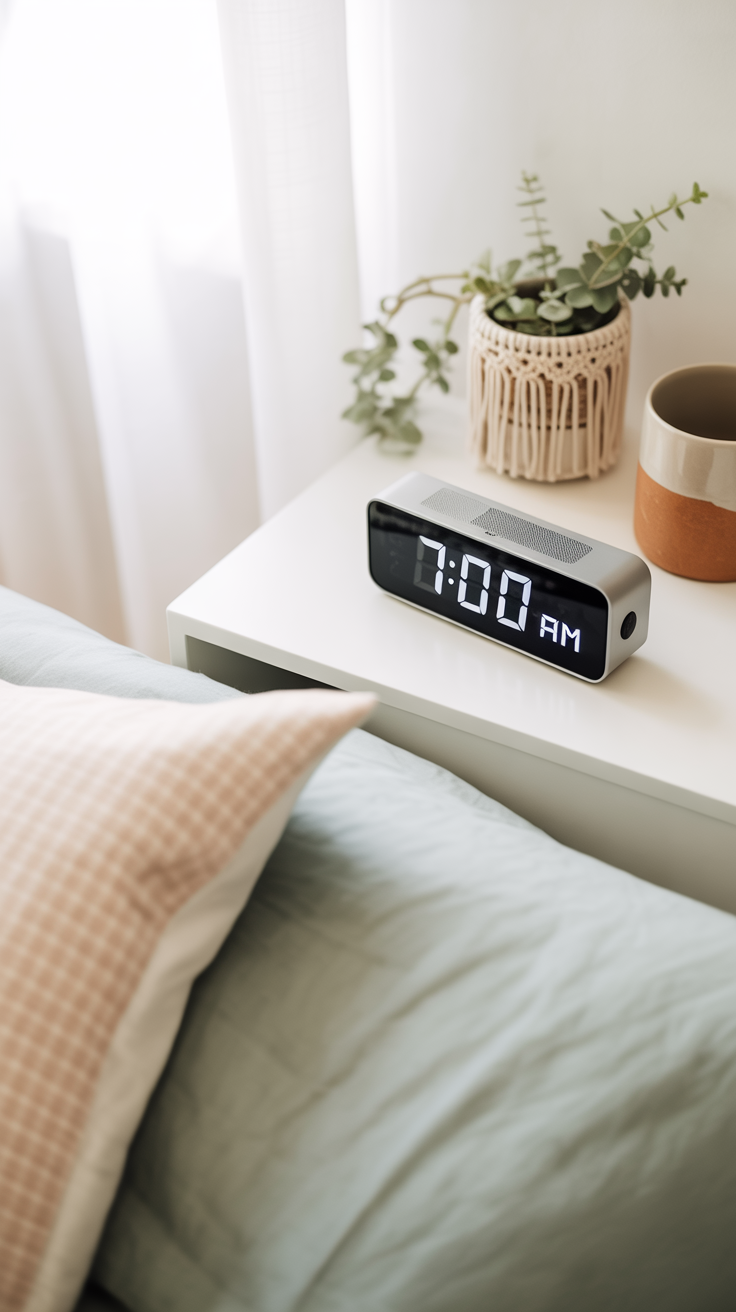
The sun hasn’t even touched the floorboards yet, but your alarm is doing that aggressive, rhythmic chirping that feels like a personal attack on your soul. You reach out, eyes still glued shut, and hit that glorious snooze button for the third time.
While it feels like a five-minute peace treaty with reality, it’s actually triggering a biological state of emergency where hitting snooze might be spiking your stress hormones to levels that leave you frazzled before you even stand up.
(I say this as I currently have three different “backup” alarms set because apparently, I don’t trust myself. I’m also currently ignoring a stack of mail on the counter and a very pressing transaction deadline, but here we are, choosing the snooze anyway).
If you have ever wondered why your morning starts with a racing heart, the answer lies in the disruption of your natural cortisol awakening response.
When you fragment your waking process, you aren’t getting restorative rest; you’re forcing your brain to restart its neurobiological boot-up sequence over and over.
This “fragmented sleep” triggers a surge in stress hormones like cortisol and adrenaline to compensate for the sudden, repetitive interruption of a new sleep cycle.
Quick Answer: Why Does Hitting The Snooze Button Increase Stress?
Hitting the snooze button increases stress because it interrupts the body’s natural transition from sleep to wakefulness, known as the “arousal” phase. When you fall back asleep for ten minutes, your brain may attempt to enter a new sleep cycle—specifically Stage 1 or REM—only to be jolted awake again moments later. This puts the body into a “fight or flight” state, leading to:
- Elevated Cortisol Levels: A sharp, artificial surge in the primary stress hormone.
- Increased Heart Rate: The “jolt” of the second alarm mimics a physical threat response.
- Prolonged Sleep Inertia: That heavy, fuzzy feeling that can last for up to four hours after waking.
- Cognitive Fog: Significant reduction in mental clarity due to interrupted sleep architecture.
What Is Sleep Inertia And Why Do I Feel So Heavy?
We have all been there. You finally roll out of bed after forty minutes of “snoozing,” and instead of feeling rested, you feel like you’ve been hit by a very soft, very upholstered truck. Everything feels clunky and slow. Your hands feel heavy, your eyes are stinging, and the thought of making a decision—any decision—feels impossible.
This state is called sleep inertia, which is the physiological state of impaired cognitive and sensory-motor performance immediately after waking. It’s that transitional period where your brain is still essentially “dimmed” because it hasn’t cleared out adenosine, the chemical that builds up during the day to make you feel sleepy. When you hit snooze and fall back into a light sleep, you are essentially tricking your brain into thinking it’s time to settle back down for a full cycle.
When the alarm goes off again ten minutes later, you’re being ripped out of the very beginning of a new sleep stage.
Your brain is confused, your hormones are scrambling, and your body responds by dumping adrenaline into your system just to get you upright. It’s not “more rest”; it’s a hormonal roller coaster that starts before you’ve even brushed your teeth.
I think back to my ten years in London, where the grey sky made it so easy to justify “just one more snooze” under a heavy duvet. But the Connecticut light is different—it’s sharper, more demanding, and it highlights the dust on my vintage 1920s Victrola that I’m definitely ignoring.
Yet, the habit remains. We are literally redlining our internal engines before we’ve even managed to find a clean pair of socks.
How Does Snoozing Disrupt Your Cortisol Awakening Response?
To understand why your morning routine might be making you anxious, we have to look at the cortisol awakening response. Naturally, your body begins to ramp up cortisol levels about thirty to forty-five minutes before you wake up, as this peak is vital for alertness and immune function. It’s a built-in “dawn simulator” designed to give you the energy to exist.
But when you hit snooze, you disrupt this delicate chemical ramp-up.
Every time the alarm blares and shocks you out of a light sleep, your brain perceives the sound as a mini-emergency. CRASH. Adrenaline. CRASH. Cortisol. You are essentially teaching your nervous system to start the day in a state of high alert rather than steady readiness. Y
ou might even find that you are showing signs of a dysregulated nervous system throughout the rest of your day because of this early morning jolt.
The Connection Between Fragmented Sleep And Morning Anxiety
You haven’t even looked at your emails yet, but you already feel behind and overwhelmed. This is often the direct result of fragmented sleep—which refers to sleep that is interrupted by frequent awakenings—caused by the snooze button.
When you sleep in ten-minute increments, that sleep is objectively low quality and metabolically useless. You aren’t reaching the restorative stages of sleep that help regulate emotional processing in the amygdala. Instead, you are lingering in a shallow, agitated state. This lack of “emotional clearing” means you head into your day with a shorter fuse and a higher baseline of irritability.
It took me way too long to realize that the “cozy” snooze was actually the catalyst for morning anxiety and the primary reason for my midday brain fog. It’s like trying to start your day by watching the first 30 seconds of a Ghost music video on loop—it’s theatrical, it’s intense, but it’s absolutely not a sustainable way to find inner peace.
You Might Also Like
I know that heavy, vibrating-chest feeling is the absolute worst when all you want is a peaceful start to your day.
How To Stop Hitting The Snooze Button For Good
If you’re looking for a way to break the cycle, it isn’t about “having more willpower.” Willpower is a finite resource, and at 6:30 AM, most of us have the willpower of a damp paper towel.
The goal is to make the “right” choice the “easy” choice for your endocrine system so you don’t have to worry about why hitting snooze might be spiking your stress hormones.
1. The “One And Done” Rule
The most effective way to protect your hormones is to set your alarm for the latest possible time you actually need to get up, and then get up the first time it goes off. This allows you to have more uninterrupted, high-quality sleep leading up to the wake-up call. It sounds scary, but your brain will actually thank you for the consistency of a single wake-up signal.
2. Prioritize Immediate Light Exposure
Cortisol is highly light-sensitive, and daylight triggers the suppression of melatonin and the release of wake-up chemicals. If you can get some natural light into your eyes within the first few minutes of waking, you signal to your brain that the “sleep” phase is officially over. Understanding these morning sunlight benefits for cortisol stabilizes your rhythm naturally.
3. The “In-Between” Ritual
Instead of snoozing, give yourself permission to be “slow” without being “asleep.” Maybe it’s five minutes of sitting up in bed with a vegan matcha—oat milk, obviously—and just staring at the wall. (This is very Golden Girls energy, honestly—just sitting there in a nightgown pondering life while the kitchen remains a disaster zone).
Why Do I Feel More Tired After Snoozing?
It feels counterintuitive, doesn’t it? You got an extra thirty minutes of “rest,” yet you feel like a total zombie. This is because the quality of those thirty minutes was essentially zero. When you snooze, you are often entering “Stage 1” sleep, which is the lightest stage where you can be easily awakened.
You’re missing out on the deep, slow-wave sleep that actually repairs your muscles and the REM sleep that processes your emotions. You’ve traded deep, healing rest for a series of shallow, stressful interruptions that leave your brain stuck in a loop.
If this exhaustion persists despite better habits, it might be worth looking into how to lower cortisol naturally and fast.
Realistic Morning Shifts For The Rest Of Us
Look, I am never going to be “that girl” who wakes up at 5 AM, runs 10 miles, and has a perfectly aesthetic life by 7 AM. My kitchen usually has a stack of mail on the counter, and I’m lucky if I remember to water my plants. But I have found that small, intentional changes make a massive difference in how my brain feels by noon.
It’s about romanticizing the “slow wake” rather than the “snooze wake.” It’s about lighting a candle while the kettle boils or listening to something that feels grounded—maybe a little Papa Emeritus IV if you need a bit of theatrical energy to get your heart beating. (I’ve been trying to build a morning routine for anxiety that doesn’t involve looking at my phone until at least 8 AM).
Try to focus on “clean living” in the morning by reducing sensory noise. This means soft lighting, no scrolling, and maybe a little clean beauty routine that makes you feel like a human again. Avoiding the cycle where hitting snooze might be spiking your stress hormones is the ultimate form of morning self-care and a key part of any calming morning routine for slow living.
A Small Shift That Changes Everything
The next time you hear that alarm, I want you to try one thing: don’t think about the day ahead. Don’t think about the emails, the messy kitchen, or the fact that you haven’t been “perfect” lately. Just focus on the physical sensation of the air in the room and the ground beneath your feet.
The goal isn’t to be a “morning person”; it’s just to be a person who is kind to their nervous system. Once you’re up, stay up. Even if you just shuffle to the kitchen to make a lukewarm vegan matcha and stare out the window at the birds, you’ve already won. You’ve protected your hormones, and you’ve given yourself a chance to start the day with a sense of calm rather than a spike of chaos.
(And if the kitchen is still messy? Let it be. We’re prioritizing the cortisol today).
Frequently Asked Questions About Why Hitting Snooze Might Be Spiking Your Stress Hormones
Why Am I So Tired After Hitting The Snooze Button?
You feel exhausted because you are likely experiencing sleep inertia, which is that heavy, “drunken” feeling caused by waking up mid-cycle. Your brain was trying to start a new restorative phase, only to be rudely interrupted by a second alarm. It is a total biological glitch and makes the rest of the day feel like you’re wading through molasses.
What Causes Morning Cortisol Spikes?
A natural surge is normal for waking up, but an artificial spike happens when your body perceives the alarm as a threat. Hitting the snooze button triggers a “fight or flight” response repeatedly, forcing your adrenal glands to dump extra stress hormones just to keep you conscious. It’s like screaming at your brain to wake up every ten minutes—which, rude.
How Can I Stop Hitting The Snooze Button Every Morning?
The best trick is to move your phone across the room so you physically have to stand up to silence it. Once you are upright and moving, your body starts clearing out adenosine naturally. It is much easier to resist the siren song of the blankets when you are already in the kitchen looking for the oat milk.
Is Hitting The Snooze Button Bad For Anxiety?
Yes, it can definitely make morning jitteriness feel much worse. By fragmenting your sleep, you are keeping your nervous system in a state of high alert. This creates a baseline of agitation (which is NOT the vibe we want) before you have even had your first sip of matcha.
Why Do I Wake Up Feeling Panicked After Snoozing?
That panic is your body’s reaction to a sudden surge of adrenaline and cortisol. When you fall into a light sleep and the alarm blares again, your brain assumes there is an emergency. Your heart rate jumps because your internal “smoke detector” is going off for no reason while you’re just trying to exist.
Can Hitting Snooze Affect My Mood All Day?
Absolutely, because fragmented sleep interferes with how your brain processes emotions in the amygdala. Starting your day with a hormonal “crash” usually leads to midday irritability and brain fog. Your brain essentially never got the memo that the “rest” portion of the program was officially over.
Read Next